

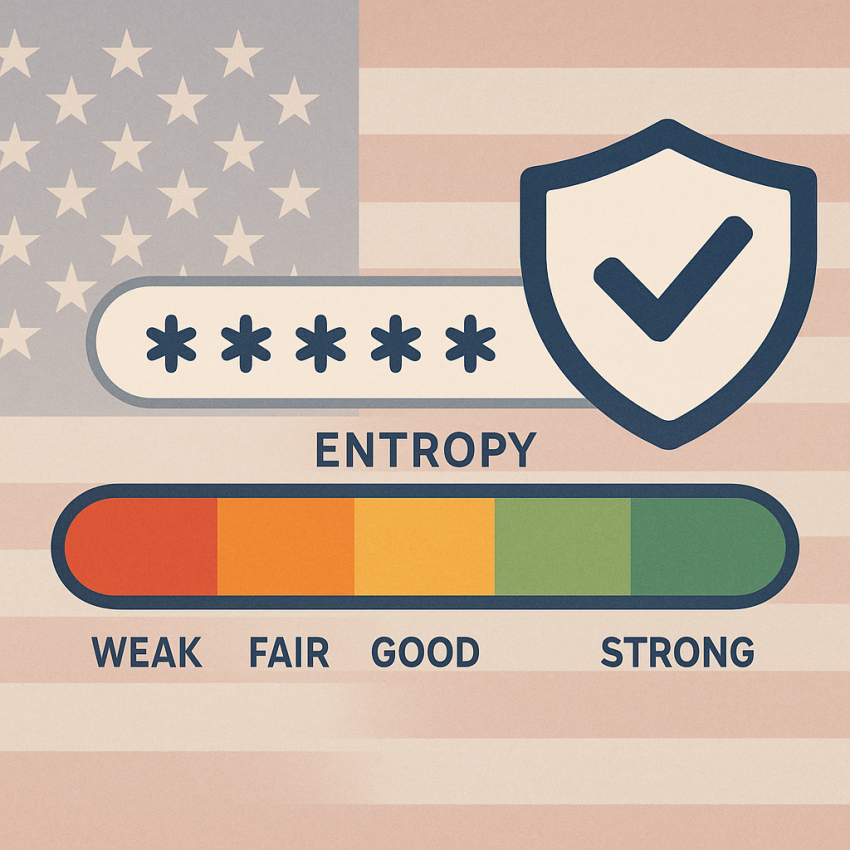

Password Entropy Explained in Simple Terms
Password entropy explained in simple terms helps you understand why long, random passwords are harder to crack. Here is a plain-language guide to how entropy works and how to improve online security.
TL;DR
- Entropy measures unpredictability of a password.
- Longer and more random characters increase entropy.
- Use passphrases and a password manager to boost entropy and security.
Why use password entropy knowledge
Understanding entropy helps you craft passwords that attackers find hard to guess. It also clarifies why simple numeric or symbolic rules aren’t enough if the password is short or predictable.
For more details on best practices, see external resources: Google Safety, Wikipedia: Password strength, and the OWASP Password Cheat Sheet.
How to improve password entropy (step-by-step)
- Choose a longer password length (12+ characters) to increase entropy.
- Use a diverse character set (lowercase, uppercase, numbers, symbols).
- Consider a passphrase made of unrelated words with random capitalization and spacing.
- Use a reputable password manager to generate and store complex passwords securely.
- Enable two-factor authentication (2FA) where available.
- Avoid common patterns, dictionary words, and obvious substitutions.
Entropy at a glance: quick table
| Entropy level | Example length | Approx. bits | Notes |
|---|---|---|---|
| Low | 8 chars | ~26-34 | Limited charset or predictable patterns |
| Medium | 12 chars | ~78 | Random but moderate length |
| High | 16 chars | ~106+ | Strong when randomness is high |
Safe and legal use
Use entropy knowledge to protect your accounts. Do not attempt to crack passwords you do not own. Always respect privacy and legal requirements.
FAQ
What is password entropy?
Password entropy is a measure of unpredictability based on the number of possible combinations. Higher entropy means a password is harder to guess.
How many bits of entropy are strong enough?
A common benchmark is 80+ bits for moderate security and 128+ bits for high security, though practical needs vary by use case.
How can I calculate entropy for a given password?
Entropy ≈ log2(N^L) where N is the size of the character set and L is the password length. More complex sets and longer length yield higher entropy.
Are passphrases more secure than short random strings?
Passphrases can be secure if they are long and generated from high-entropy sources, but random characters across a large charset are typically more unpredictable per character.
Does entropy relate to password length?
Yes. Longer passwords generally have higher entropy, provided they are not predictable or repetitive.
How does entropy interact with two-factor authentication?
Two-factor authentication adds an extra security layer, making even lower-entropy passwords harder to compromise.
Take action now
Boost your security with a strong password strategy. Use our password generator and read more about best practices.
Try the Password Generator — and check Google Safety for tips on protecting accounts, or learn from Wikipedia: Password strength.
Need more insights? Explore our blog for related topics about secure authentication and user verification.